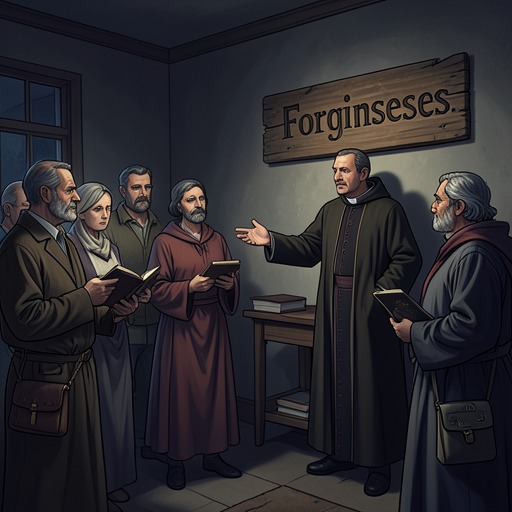
Christian forgiveness and moral responsibility
In Cold BloodChristian forgiveness and moral responsibility are presented not as alternatives but as obligations that must be held together. Forgiveness refuses to answer violence with another killing; responsibility insists that a person acknowledge the harm done and accept the claims of other people. The book gives these principles different voices and settings: the Deweys’ ordinary religious routines, a public plea for mercy after the Clutter family’s deaths, and a sister’s unsparing letter to Perry Smith about his choices and the pain they have caused.
Faith in ordinary life
For Alvin Dewey and Marie Dewey, belief in God was not confined to crisis or public declaration. Church every Sunday, grace before meals, and prayers before bed formed part of the household’s ordinary pattern. Marie described gratitude as something she wanted to express, not merely an obligation: even after work, with coffee on the stove and a steak in the icebox, the family could cook supper, talk about the day, and recognize cause for thankfulness. The religious practice is shown through domestic gestures and shared time rather than abstract doctrine.
That routine gives particular weight to Marie’s question about whether the couple would ever have a normal life again. Alvin began to answer, but the telephone interrupted him. The unanswered question places their faith beside the strain of the events around them: religious observance continues, yet it does not make the disruption disappear. Their hoped-for future also has a concrete form. They were saving to build a house on the 240 acres Alvin had bought in 1951, several miles north of Garden City; he imagined planting a garden and trees on the open plains. His hope that the oasis would someday stand there, God willing, joins religious trust to a patient, practical vision of a life still to be made.
Forgiveness without retaliation
After Beverly Clutter’s wedding, as the Clutter relatives dispersed from Garden City, the Garden City Telegram printed a letter from Howard Fox, Bonnie Clutter’s brother. The letter first thanked townspeople for opening their homes and hearts to the bereaved family, then addressed the anger circulating in the community. Fox had heard calls for the person responsible to be hanged from the nearest tree. He urged readers not to give way to that demand: the deed had been done, and taking another life could not change it.
Fox’s appeal grounds forgiveness in Christian belief. He asks the community to forgive as God would, to refuse a grudge, and to pray that the perpetrator might find peace through seeking God’s forgiveness. The letter does not deny the crime or promise that its consequences can be undone. Instead, it distinguishes the wrong already committed from a new act of vengeance. The person responsible, Fox argues, will have difficulty living with himself; the community should not obstruct the possibility of repentance by answering death with death. Forgiveness here is a public discipline as well as a spiritual hope: it asks grieving and angry people to govern their response, even when they cannot reverse their loss.
Barbara Johnson’s appeal to personal responsibility
Barbara Johnson’s letter to her imprisoned brother, Perry Smith, makes the other side of the ethic more intimate and confrontational. Dated April 28, 1958, it was written when Perry had been imprisoned for about two years. Barbara describes a busy household with young children, then turns from family news to the argument she believes her brother needs to face. She allows that environment matters and recalls the influence of the convent in her own life, but she rejects environment as a complete explanation or an excuse that transfers responsibility to someone else.
Barbara argues that people understand the difference between right and wrong from an early age, and says that what Perry has done, whether right or wrong, is his own doing. Her comparison between a dirty face and the shame of keeping it dirty makes the point memorable: a failing is not beyond response, but refusing to confront it compounds the failure. She applies that challenge to Perry’s attitude toward both his confinement and their father, Tex John Smith. In her view, the letter he had sent blamed others for his troubles while showing too little sincere regret or respect for laws and people. She asks him to consider how his conduct has hurt the family, especially their father, whose heart she says is broken and who longs for his son.
Her insistence on responsibility is not a claim that human beings have no weaknesses. Barbara acknowledges her own shortcomings and mistakes, and remembers Jimmy Smith as someone who worked and went to school through his own will, without anyone having to direct him. Yet she distinguishes vulnerability from evasion: Perry’s intelligence and ability, she says, matter only if he is willing to work honestly toward a purpose. The letter’s force comes partly from the risk Barbara recognizes in writing it. She anticipates that he may not answer or may respond with anger, but writes because she believes he must hear how another person sees his conduct.
Freedom, compassion, and obligation
Barbara’s argument broadens from the family to the community. A person is responsible to the community and its laws, she writes, and freedom of speech and action has a limit when it injures another person. The examples of a home, children, and business give that principle practical substance: accepting responsibility is part of adult life, not an optional surrender of individuality. She warns that a society in which everyone claimed the right to act without responsibility to others would become a mess.
Her appeal also links moral conduct to compassion. Living without feeling for fellow human beings, she argues, reduces a person to the logic of retaliation—an eye for an eye—rather than bringing happiness or peace of mind. Read alongside Fox’s letter, that warning clarifies the difference between responsibility and revenge. Accountability means that a person cannot disown his choices or the harm they cause; forgiveness means that the community need not reproduce that harm in the name of answering it. The Deweys’ habitual prayers, Fox’s plea to a grieving town, and Barbara’s family letter thus give the principle three scales: daily gratitude, collective restraint, and the difficult demand that an individual accept responsibility for the life he has made.